The Book
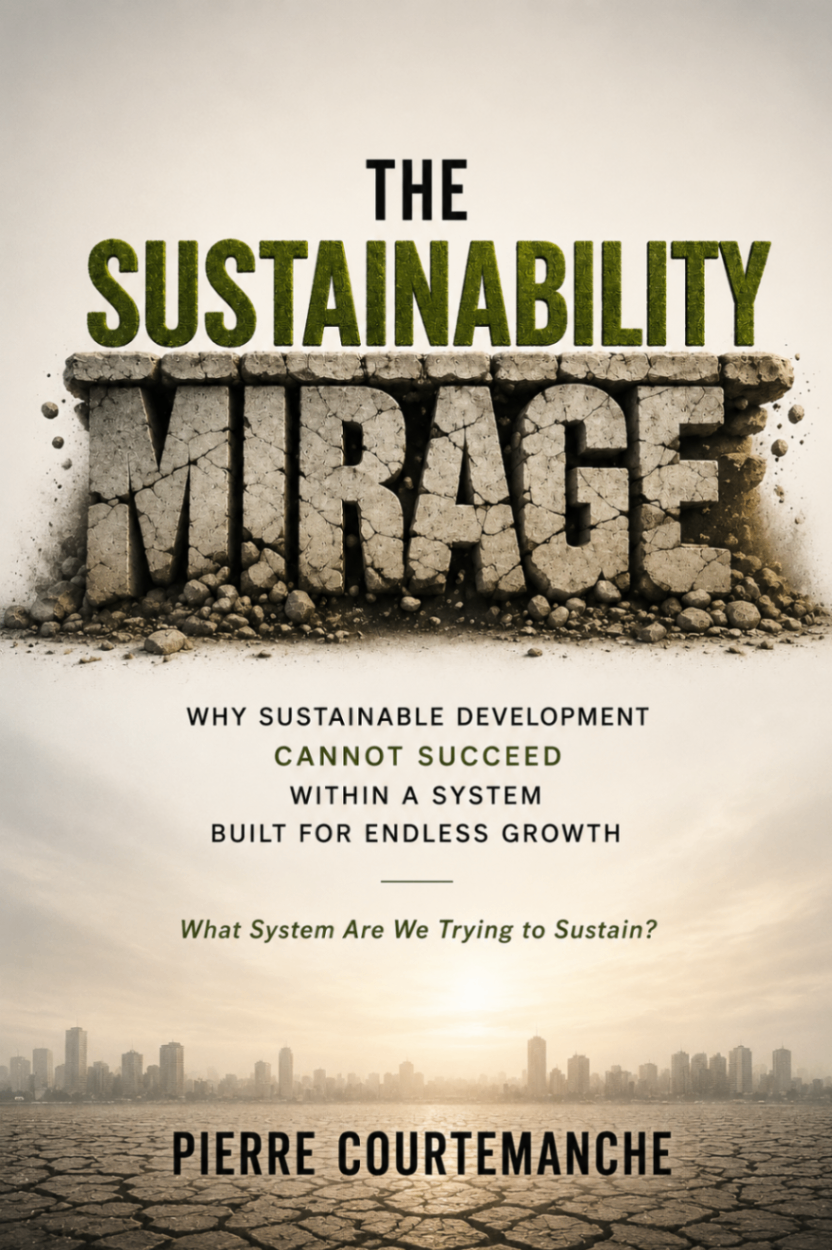
The Sustainability
Mirage
Why Sustainable Development Cannot Succeed Within a System Built for Endless Growth
Pierre Courtemanche
Forthcoming
The Question
For more than half a century, governments, corporations, investors, NGOs, and international institutions have pursued a common objective: sustainable development.
The ambition is simple. To create a future where economic prosperity, social progress, and environmental protection advance together.
Yet despite unprecedented investments, technological advances, reporting frameworks, certifications, regulations, and corporate commitments, many of the trends sustainability was meant to address continue to worsen.
Resource extraction continues to grow.
Material consumption continues to expand.
Waste generation continues to increase.
Ecosystems continue to degrade.
Inequalities continue to widen.
Why?
The question is no longer whether we are trying.
The question is why the results remain so elusive.
The Argument
Most sustainability discussions focus on solutions — better technology, stronger regulations, more rigorous reporting, greater corporate commitment.
This book focuses on a different question.
What if sustainability is not struggling because we lack information, technology, regulations, standards, or commitments? What if the challenge lies within the incentives and structures of the system itself?
This question became the starting point for The Sustainability Mirage.
The Central Question
"What system are we
trying to sustain?"
This is not a rhetorical question. It is the lens through which every chapter of the book is written.
Inside the Book
What the book explores
Drawing from more than four decades of experience in international development, entrepreneurship, and global supply chains, Pierre Courtemanche combines historical analysis, systems thinking, and direct observation from inside the institutions that sustainability seeks to influence.
Earth is a finite system
The historical origins of modern corporations and the rise of perpetual economic growth as a societal objective
The evolution of sustainability as a global movement — and the gap between its ambitions and real-world outcomes
The role of technology, reporting frameworks, and regulation in shaping — and limiting — sustainability practice
The incentive structures embedded in corporations, governments, and international institutions
The limits of current approaches and the questions they leave unanswered
Alternative ways of thinking about progress, development, and the relationship between economy and ecology
Why I Wrote This Book
Over the years, I found myself asking the same question repeatedly.
If so many intelligent and well-intentioned people are working on sustainability, why do many of the underlying trends continue in the wrong direction?
This book is not an attempt to criticize those efforts.
It is an attempt to understand why they often struggle to produce results proportional to the scale of the challenges they seek to address.
The Sustainability Mirage emerged from that search for understanding.
Selected Excerpts
The following passages offer a brief glimpse into the themes explored throughout The Sustainability Mirage.
The concept of sustainability is now everywhere.
It permeates economic, social, and scientific discourse. It shapes corporate strategies, political agendas, school curricula, and public narratives. It is repeated endlessly — especially across Europe and North America — and is increasingly embedded in the language of global business.
This ubiquity creates a particular impression: that the problem is being actively managed and progressively resolved.
Yet observable trends suggest otherwise.
Across sectors, geographies, and industries, a pattern emerges.
Systems do not fail because they lack information.
They do not fail because solutions are unavailable.
They fail because contradictions are absorbed faster than they are resolved.
Signals are received. Adjustments are made. Narratives evolve.
But the underlying dynamics remain unchanged.
This book was not written from a university office, a government department, or an activist organization.
It was written by someone who spent four decades inside the system, trying to make it work better.
Forthcoming
The Sustainability Mirage does not claim to offer simple answers.
Instead, it asks a question that has become increasingly difficult to ignore: can sustainable development succeed within a system designed for perpetual growth?
The answer matters because the future may depend on it.
Receive updates on the book, new essays, publication news, and ongoing discussions inspired by The Sustainability Mirage.